A new marketing leader often arrives under pressure to produce visible activity.
The chief executive officer wants momentum. The team wants direction. Sales wants more qualified opportunities. Agencies want decisions. Leadership may already have a list of campaigns, website changes, technology purchases, and overdue projects.
The temptation is to prove value by launching something quickly.
That may create motion. It can also lock the organization into assumptions that have not been tested.
The short answer
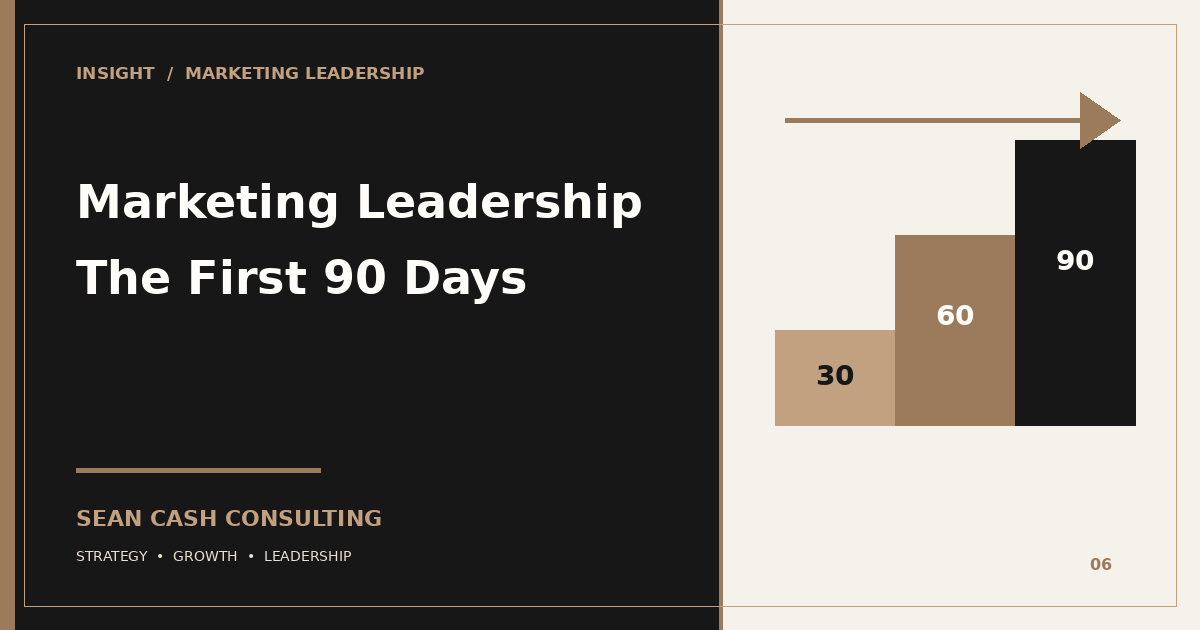
During the first 90 days, a marketing leader should diagnose before prescribing, establish the few decisions that matter most, align people and resources, and convert strategy into an accountable operating plan. The goal is not to complete every marketing project. It is to build enough clarity and discipline that the organization knows what to do, why it matters, who owns it, and how progress will be judged.
What should exist after 90 days
The exact work will vary, but a chief executive officer should expect several tangible outcomes:
- A clear assessment of the current marketing system
- Agreement on the highest-priority customer and growth objectives
- A defensible position and value proposition, or a plan to resolve them
- Defined roles for the internal team, sales, agencies, and other partners
- A focused 90-day operating plan connected to the business strategy
- Budget and resource recommendations
- A small set of meaningful performance indicators
- A regular decision and reporting cadence
- A documented list of what will stop, wait, or receive less attention
If the first 90 days produce only a larger activity calendar, the organization may have hired a campaign manager when it needed a marketing leader.
Days 1–30: Understand the business before changing the marketing
The first month should establish the facts, relationships, and context required for sound decisions.
Learn how the business creates value
Marketing cannot be separated from the economic model. The leader needs to understand:
- Revenue sources and growth expectations
- Products, services, and margins
- Customer acquisition and retention patterns
- Sales cycles and buying processes
- Capacity constraints
- Competitive pressures
- Strategic changes already underway
This prevents the marketing plan from optimizing a metric that does not address the real business need.
Listen across the organization
Customers experience the organization as one system even when employees work in departments. The leader should speak with executives, sales, operations, service, product, finance, and frontline employees.
The objective is not consensus on every issue. It is to identify where assumptions differ, where handoffs fail, and where valuable knowledge is trapped inside separate functions.
Examine the customer evidence
Internal opinion is not customer insight. Review available research, sales notes, win-loss information, service issues, reviews, web behavior, retention patterns, and customer interviews.
Ask:
- Which customers create the strongest mutual value?
- What problem causes them to act?
- Why do they choose the organization?
- Where do prospects hesitate or leave?
- Which promises are difficult to deliver consistently?
Audit the marketing system
The audit should cover more than campaigns. It should examine strategy, position, content, channels, technology, agencies, team capability, budget, data, customer journey, and measurement.
The leader is looking for connections and constraints. A weak conversion rate may be a message problem, a qualification problem, a sales-process problem, or a poor offer. More traffic will not repair all four.
Days 31–60: Focus the organization on the decisions that matter
The second month should convert diagnosis into choices.
Define the priority business outcome
“Grow revenue” is not specific enough. The priority might be increasing qualified opportunities, improving conversion, shortening the sales cycle, protecting retention, increasing customer value, entering a segment, or supporting a new offer.
The choice should change what the organization funds and measures.
Clarify the audience and position
The organization needs a shared answer to several questions:
- Who has priority?
- What problem are we especially qualified to solve?
- What value matters to that audience?
- Why should they choose us?
- What proof makes the claim credible?
Without those choices, teams and agencies create polished variations of an unclear story.
Identify the critical constraints
Marketing plans often fail because they ignore the factor limiting growth.
The constraint may be weak awareness, unclear positioning, insufficient demand, slow follow-up, poor conversion, customer churn, limited capacity, pricing, or a fragmented customer experience.
The leader should identify which constraint deserves attention now and which issues can wait.
Align the resources
Review whether the current team, agencies, technology, and budget match the chosen priorities. This may require changing an agency scope, clarifying internal roles, developing employees, stopping a tool, or adding specialist support.
The question is not whether every resource is useful. It is whether the collection of resources operates as one system.
Days 61–90: Build the operating model
The final month should turn the strategic choices into an executable plan.
Establish a 90-day plan
The plan should specify:
- The business outcome and priority audience
- The customer behavior the organization wants to influence
- The position, message, and offer
- The coordinated actions across marketing, sales, and customer experience
- The person accountable for each action
- The resources and budget required
- The measures and review dates
- The assumptions that need to be tested
This is a management document, not a presentation designed to impress the room.
Build an executive dashboard
A useful dashboard connects marketing activity to movement through the commercial system. Depending on the strategy, it may include qualified opportunities, conversion, sales velocity, acquisition cost, retention, customer value, pipeline contribution, or another business measure.
The dashboard should help leaders decide, not merely observe.
Create a working cadence
Set expectations for team meetings, agency reviews, executive reporting, experiments, budget decisions, and performance conversations.
Accountability improves when people know when decisions will be made and which evidence will be used.
Launch selectively
The organization does not need to wait 90 days before doing anything. Obvious problems can be corrected, customer conversations can begin, and well-supported work can continue.
The difference is that early action should create learning or remove clear friction. It should not become a substitute for the strategic work.
What the CEO must provide
Marketing leadership cannot succeed without executive access and organizational cooperation.
The CEO should provide:
- Direct access to business strategy and financial context
- Honest discussion of constraints and expectations
- Access to customers, employees, data, and partners
- Authority proportionate to the responsibility assigned
- Timely decisions when priorities conflict
- Support for stopping work that no longer fits
Hiring a marketing leader while withholding information, authority, or access creates accountability without control.
Warning signs in the first 90 days
Leaders should be cautious if the new marketing executive:
- Prescribes major tactics before understanding the customer and business
- Treats every problem as a channel or technology problem
- Reports activity without connecting it to a decision
- Avoids difficult conversations about priorities and resources
- Adds projects without stopping anything
- Operates marketing separately from sales and customer experience
- Promises immediate results that the buying cycle cannot support
Confidence matters. So does intellectual honesty.
The first 90 days should improve future decisions
Strong marketing leadership does more than produce a plan. It gives the organization a clearer way to make decisions after the initial assessment is complete.
That means shared priorities, useful measures, defined roles, disciplined review, and a team that understands how its work contributes to the business.
The results in the Pixius commercial transformation and Link Media scale case study illustrate what becomes possible when marketing leadership connects strategy, sales, customer value, and operations.
If your organization needs senior direction but is not ready for a permanent executive hire, fractional CMO leadership can provide a practical way to build that operating discipline.