Organizations often know they need marketing help before they understand what kind of help they need.
The website needs work. Leads are inconsistent. Agencies are busy, but no one is sure whether their activity supports the business strategy. The internal team wants clearer priorities. Sales believes marketing should produce better opportunities. The founder is still making most of the important marketing decisions.
At that point, leaders may begin searching for a fractional chief marketing officer, a marketing consultant, an agency, or a full-time CMO. Those options are sometimes treated as interchangeable. They are not.
The short answer
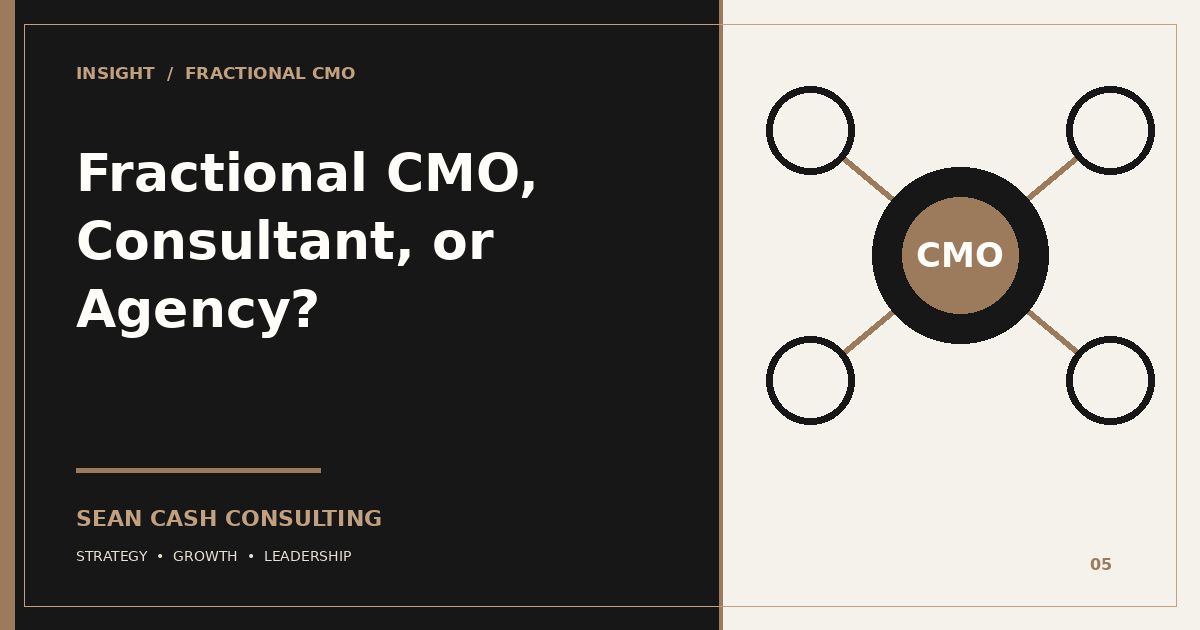
A fractional CMO provides part-time executive ownership of the marketing function. A marketing consultant advises the organization on a defined problem. An agency supplies specialized execution capacity. A full-time CMO provides permanent executive leadership when the scale, complexity, and workload justify the investment.
The right choice depends less on company size than on the problem that must be solved.
Four models, four different jobs
A marketing agency executes specialized work
An agency is usually the right choice when the organization knows what it wants to accomplish and needs people with particular capabilities to execute it.
That may include:
- Paid media
- Search-engine optimization
- Website development
- Public relations
- Creative production
- Social media
- Content development
- Marketing automation
A strong agency can improve quality, speed, and access to specialist talent. It should not be expected to resolve every strategic question or lead the entire marketing organization unless that responsibility is explicitly part of the engagement.
An agency can build an excellent campaign and still be operating from an unclear position, an unrealistic objective, or a fragmented customer journey. Execution quality does not automatically create strategic coherence.
A marketing consultant solves a defined problem
A consultant is valuable when leadership needs independent expertise, analysis, or recommendations related to a specific challenge.
Examples include:
- Market research
- Brand positioning
- Go-to-market planning
- Customer segmentation
- Pricing analysis
- Marketing-technology selection
- Campaign or performance assessment
The consultant may diagnose the issue, facilitate decisions, and develop a plan. The organization normally retains responsibility for implementing the recommendations and coordinating the people involved.
This model works well when the question is bounded and someone inside the organization can own what happens next.
A fractional CMO leads the function
A fractional CMO is appropriate when the organization does not merely need another recommendation or vendor. It needs a senior leader who can connect business strategy to marketing priorities and accept responsibility for the operating system.
That responsibility may include:
- Establishing the marketing strategy and annual plan
- Defining priority customers and market position
- Aligning marketing with sales and customer experience
- Leading the internal team
- Selecting and managing agencies and specialists
- Allocating budget and resources
- Building performance measures and executive reporting
- Improving marketing processes and technology
- Advising the chief executive officer and leadership team
The fractional model provides that leadership on a part-time or interim basis. The role should have enough authority, access, and continuity to influence real decisions, not simply attend meetings and offer occasional advice.
A full-time CMO builds permanent executive capacity
A full-time CMO becomes appropriate when the organization has enough scale, complexity, budget, and leadership workload to require a permanent executive.
The decision should not be based only on revenue. Consider the number of markets, products, customer segments, employees, agencies, channels, acquisitions, and strategic changes the leader must manage.
A fractional CMO may also help prepare the organization for that hire by clarifying the strategy, improving the team, documenting the operating model, and defining what the permanent role needs to accomplish.
Five questions that clarify the choice
1. Is the problem execution or direction?
If the strategy is clear and the organization lacks a capability, an agency may be the answer.
If leadership cannot agree on customers, position, priorities, budget, measures, or the role of marketing, adding more execution capacity may create more activity without better results. That is a leadership problem.
2. Who owns the whole marketing system?
Agencies and internal specialists usually own portions of the work. Someone still needs to connect brand, demand generation, sales support, customer experience, analytics, technology, and budget decisions.
If no senior leader owns the whole system, the organization may need a fractional or full-time CMO.
3. Can the internal team implement the recommendation?
A strategic plan creates limited value when no one has the authority or time to turn it into operating priorities.
If the organization already has a capable executive sponsor and team, a consultant may provide exactly the expertise required. If implementation needs ongoing leadership, the fractional model is more suitable.
4. How much change is involved?
A focused campaign is different from entering a new market, integrating acquisitions, rebuilding a brand, developing a marketing function, or changing how sales and marketing work together.
The broader the change, the more likely the organization needs leadership rather than a single service.
5. What should success look like six months from now?
The desired outcome should determine the model.
If success means a new website or better paid-media performance, hire the appropriate specialist. If success means a clear strategy, aligned team, accountable agencies, disciplined budget, useful dashboard, and stronger commercial execution, assign executive ownership.
The best answer may be a combination
These models do not have to compete.
A fractional CMO may lead an internal team, retain a specialized agency, and use a consultant for focused research. The value comes from assigning each party the right responsibility.
The CMO should not try to become every specialist. The agency should not be forced to make executive decisions it was not hired or equipped to make. The consultant should not be blamed when recommendations fail because no one owns implementation.
Clear roles improve the work.
What to expect from a fractional CMO
The first stage should create clarity, not a burst of disconnected tactics. A useful engagement normally begins by examining:
- Business objectives and growth constraints
- Customer and market priorities
- Position and value proposition
- Current marketing, sales, and customer journey
- Team, agencies, technology, and budget
- Measures, reporting, and decision processes
The result should be a focused operating plan that tells people what matters, who owns it, how resources will be used, and how leadership will evaluate progress.
That is the distinction between additional marketing help and fractional CMO leadership.
Choose the responsibility before the provider
Before interviewing firms or candidates, define the responsibility the organization is prepared to assign.
Do you need someone to execute a known strategy? Advise on a specific problem? Lead the entire marketing function? Build permanent executive capacity?
The wrong model can make a capable partner appear ineffective. The right model gives strategy, leadership, and execution a clear place in the system.
If your organization is uncertain whether the need is executive leadership, a strategic project, or specialized execution, start with a conversation about the problem, not a predetermined solution.